You signed up for the promise. You watched the demo, saw the cost-per-call numbers, and thought: this changes everything. The AI platform was affordable, setup seemed fast, and the pitch made managing a 50-seat outbound floor sound as simple as flipping a switch.
Six months later, your dial volume is up. Your cost per seat is down. And your revenue is… flat. Maybe worse.
Welcome to the ghost cost problem, the invisible tax that unmanaged AI calling inflicts on businesses that mistake cheap for efficient.
This article is a full breakdown of what those costs actually look like, where they hide, and what separates AI that generates genuine ROI from AI that quietly destroys it.
What Are Ghost Costs?
The Ghost Cost of AI
What are the ghost costs of AI? They are the invisible revenue leaks, spam-labeled numbers, lead burn, and TCPA liabilities that occur when using unmanaged software-only tools. In 2026, the Total Cost of Ownership (TCO) for “cheap” AI is often 3x higher than managed infrastructure due to a 50-80% collapse in answer rates.
The term “ghost cost” refers to expenses that never appear on a single line item but show up everywhere in your outcomes: lost revenue, wasted leads, compliance penalties, damaged brand reputation, and the hidden labor of managing a system that was sold as self-managing.
In traditional outbound sales, ghost costs were manageable. You could see them: a rep who underperformed, a script that wasn’t converting, and a shift that had too many missed calls. The inefficiency was visible and fixable.
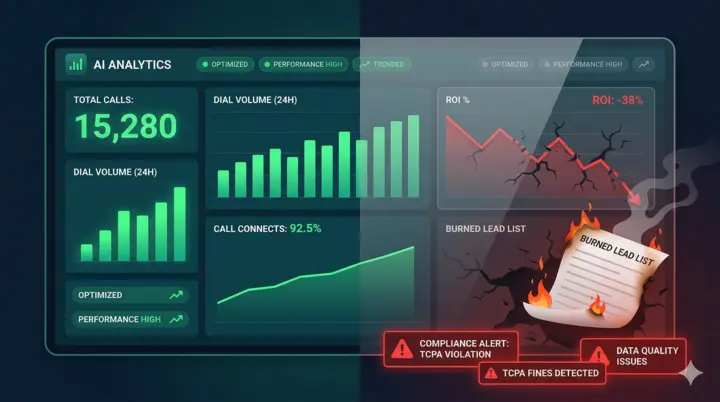
With unmanaged AI, ghost costs are far more insidious. They hide behind impressive-sounding metrics. Your dashboard shows thousands of calls placed. What it doesn’t show is how many were answered, how many got flagged as spam before a human ever picked up, how many violated a state dialing rule, or how many burned a perfectly good lead forever.
That gap, between what your AI reports and what’s actually happening, is where ghost costs live.
Ghost Cost #1: The Spam Label Erosion
Here is one of the most underappreciated problems in AI outbound calling: your number might already be flagged before you place a single call.
Carriers like T-Mobile, Verizon, and AT&T run sophisticated algorithms that score phone numbers based on call behavior: how many calls are placed per hour, how many are answered, and how many recipients flag the call as unwanted. When a number accumulates a bad behavioral profile, it gets labeled. Depending on the carrier and the recipient’s phone, that label might show up as “Spam Risk,” “Likely Spam,” or simply “Scam Likely.”
What happens when that label appears? The answer rate collapses. Studies on outbound sales consistently show that labeled numbers see answer rates drop between 50% and 80% compared to clean, unregistered numbers.
Now do the math on your AI calling platform.
If you’re paying for 10,000 outbound calls per month and only 20% are answered because your numbers are labeled, you’re effectively paying for 10,000 calls but getting the output of 2,000. The rest is money directly incinerated. Your cost per conversation, the only metric that actually is relevant for revenue, is five times higher than what the platform’s price sheet suggests.
And here’s the part that most cheap AI platforms don’t tell you: they share number pools. Multiple customers might be calling from the same phone numbers, sharing a reputation that none of them can individually control. One bad actor on that shared pool can destroy answer rates for every business using it.
Unmanaged AI doesn’t solve this. It doesn’t purchase dedicated numbers. It doesn’t register and whitelist those numbers with carriers. It doesn’t monitor those numbers continuously for spam flagging and pulls them the moment they’re marked. It sells you the calling capability and leaves the number reputation entirely to chance.
Fixing the problem requires more than new numbers; it requires a technical whitelisting strategy to ensure your ID is registered with carriers.
Ghost Cost #2: The Lead Burn Problem
A lead is not an infinitely renewable resource. Every number in your database represents a real person who expressed some level of interest; they filled out a form, clicked an ad, and responded to an email. That interest has a shelf life, and it can be permanently destroyed.
When an unmanaged AI calls a lead at the wrong time, say, 8:00 AM on a Sunday, or back-to-back three times in a single day, or with a number that’s been spam-labeled, one of two things happens.
First, they don’t answer. The lead goes cold. You’ve used up one of your contact attempts and gotten nothing.
Second, and far worse, they answer, and they’re furious. They didn’t ask for this call. The timing is terrible. The AI sounds robotic or stumbles over their name. They hang up, and they never want to hear from your company again. That lead is now actively hostile. If they’re the kind of person who leaves reviews or reports spam numbers, you now have a real problem.
The cost of a burned lead is almost never calculated in ROI analyses for AI calling platforms, because it’s difficult to assign a dollar value to a lead that would have converted if handled properly but now never will. But the cost is very real. In high-ticket industries like mortgages, insurance, debt relief, and solar, a single converted lead might be worth $500 to $5,000 in revenue. A platform that burns 20% of your leads through poor timing, bad call behavior, or spam-labeled numbers has a hidden cost that can be catastrophic at scale.
Ghost Cost #3: The TCPA Time Bomb
The Telephone Consumer Protection Act is the most consequential law governing outbound calling in the United States, and it is not forgiving.
Under the TCPA, businesses that place calls using automated technology, including AI, without proper prior written consent from the recipient can face statutory damages of $500 to $1,500 per call. Not per campaign. Not per day. Per call.
If you’re placing 5,000 calls per day and 1% of those calls are technically non-compliant, wrong time, unconsented contact, and improper DNC suppression, that’s 50 potential violations per day. At $500 minimum, that’s $25,000 in daily exposure. Over a month, that’s $750,000. And TCPA class action attorneys are excellent at finding these patterns.
State-level regulations add another layer entirely. Many states have their own dialing restrictions that go beyond the federal framework:
- Some states prohibit calls before 9 AM or after 8 PM in the recipient’s local time zone.
- Several states cap how many times you can call the same number in a single day or week.
- States with emergency declarations or holidays often have additional restrictions.
- California, Florida, and others have added their own consent and disclosure requirements that layer on top of federal rules.
Unmanaged AI platforms typically enforce federal rules at best. They do not build state-by-state logic into their dialing systems. They do not automatically detect when a number is calling into a restricted time zone. They do not pause campaigns for state holidays. They don’t validate that the consent token on a lead was properly captured.
All of that enforcement falls on you, the business owner or call center manager. And when a violation occurs, the business bears the liability, not the software vendor.
The ghost cost here isn’t the $500 per call statutory minimum. It’s the class action lawsuit. It’s the legal defense cost. It’s the FCC investigation. It’s the reputational damage when your company name appears in court filings that are indexed by Google.
TCPA litigation has grown significantly year-over-year. The legal landscape in 2026 is stricter than it has ever been. Businesses that deploy AI outbound calling without comprehensive, automated, continuously enforced compliance infrastructure are operating a time bomb, not a growth tool.
For a deep dive into the legal requirements, see our 2026 Guide to TCPA Compliance for AI.
Ghost Cost #4: The Hidden Labor Tax
One of the most seductive promises of AI outbound calling is that it eliminates the need for human oversight. Set it up, let it run, watch the leads roll in.
This is almost never how it works in practice with unmanaged platforms.
Someone has to write the prompts. Someone has to test them. Someone has to analyze why calls aren’t converting and decide what to change. Someone has to monitor the number reputation. Someone has to check compliance. Someone has to integrate the platform with your CRM, and then fix it when the integration breaks. Someone has to build the qualification logic. Someone has to pull the reports and interpret what they mean.
With cheap, self-serve AI platforms, all of that work lands on your team. And your team is probably not a team of AI prompt engineers, telephony compliance specialists, and CRM integration developers. They’re sales managers who now spend hours every week wrestling with a system they don’t fully understand.
The hidden labor cost of unmanaged AI is enormous. A sales manager spending 15 hours a week on AI platform configuration and troubleshooting instead of coaching reps, reviewing conversion strategy, or managing pipeline is a ghost cost that never appears in the platform’s pricing.
Neither does the cost of mistakes made by non-experts configuring a system with real compliance consequences. A misconfigured dialing window. A missed DNC inspection. A consent validation step was skipped to launch faster. These aren’t just inefficiencies; they’re liabilities.
Ghost Cost #5: The Conversion Quality Gap
Not all AI is created equal when it comes to actually converting leads. And the gap between a high-quality AI calling system and a cheap one isn’t just about voice quality; it’s about the entire structure of the conversation.
Cheap AI platforms give you a voice. That voice reads a script. If the lead says something unexpected, the AI either stumbles, falls back on a generic response, or ends the call. The conversation feels transactional, robotic, and impersonal. In high-consideration purchases, insurance, mortgages, and debt relief, this kind of interaction produces low trust, low conversion, and a lot of “I’ll call you back” responses that never materialize.
High-quality AI calling systems are designed around conversational intelligence, not just script execution. They can handle objections. They can pivot based on what the lead says. They can capture structured qualification data, adjust tone for different segments, and create an interaction that genuinely builds enough trust to move a lead toward the next step.
The conversion rate gap between these two approaches can be dramatic, sometimes 2x to 5x. When you’re paying per minute or per call, a platform that converts at 2% sounds cheaper than one that costs more but converts at 8%. It almost never is, once you do the full math on cost per converted lead.
Ghost Cost #6: The CRM Chaos Tax
Your AI calling platform is only as valuable as what happens to the data after the call. In most unmanaged systems, what happens to the data is not enough.
You get a call log. Maybe a recording. Possibly a transcript. What you often don’t get is structured, actionable data automatically pushed into your CRM — the disposition, the qualification answers, the specific outcome of the call, and the next step triggered.
Without that structured data flowing automatically into your CRM, one of two things happens. Either your team manually reviews calls and logs data, which is expensive, slow, and inconsistent. Or the data doesn’t get logged at all, and you’re making decisions about your campaign based on incomplete information.
The ghost cost here is twofold. First, there’s the raw labor cost of manual data entry and call review. Second, and more expensive, is the cost of poor decisions made on bad data. If you can’t see that 40% of your calls are ending at a specific point in the conversation, you can’t fix the script. If you can’t see which lead sources are converting and which are burning, you can’t reallocate your budget. You’re flying blind, and every blind decision is a ghost cost.
Ghost Cost #7: The Optimization Vacuum
Outbound AI calling isn’t a “set it and forget it” operation. The best campaigns improve over time through continuous optimization: A/B testing different openers, refining qualification questions, adjusting call timing, modifying transfer logic, and updating scripts based on actual call data.
Unmanaged AI platforms typically give you the tools to make changes, but they don’t make the changes for you, and they don’t tell you what needs to change. You’re handed raw data and expected to derive insights, prioritize tests, and implement improvements on your own.
For teams without dedicated analysts or AI optimization expertise, this means campaigns run unchanged for months. The script that was mediocre on day one is still running on day ninety. The objection that kills 30% of calls in the first sixty seconds has never been addressed because no one noticed the pattern.
The cost of an unoptimized campaign isn’t the cost of the calls you’re running. It’s the cost of the calls you could be converting if the campaign were performing at its potential. This is a ghost cost that compounds over time, growing larger every month the campaign runs without improvement.
What Managed AI Calling Actually Includes
The contrast between cheap and effective AI calling comes down to what happens around the call, not just during it. Here’s what genuine, managed AI calling infrastructure includes:
- Number Acquisition and Reputation Management. Hundreds of phone numbers were purchased, registered with carriers, and continuously whitelisted. Numbers were monitored in real time and replaced the moment they showed spam signals.
- Local Presence Dialing. Calls appear to come from local area codes matching the recipient’s geography. This alone can double answer rates in many markets.
- Automated, Comprehensive Compliance. Federal TCPA rules, state-by-state dialing windows, velocity caps, holiday restrictions, and emergency state rules, all enforced at the system level without relying on manual oversight. Real-time opt-out detection and suppression across voice and SMS channels.
- Consent Validation. Integration with consent verification systems like TrustedForm to ensure every call is legally defensible before it’s placed.
- CRM Integration and Data Automation. Full call transcripts, recordings, dispositions, qualification answers, and conversion events are pushed directly into your CRM after every call. No manual logging, no data gaps.
- Continuous Campaign Optimization. Prompt design, A/B testing, qualification logic refinement, and transfer logic adjustment are all managed on an ongoing basis by people who specialize in this, not by your sales team in their spare time.
- A Dedicated Accountability Partner. Someone who owns your campaign performance, not just your subscription.
Who Pays the Highest Ghost Cost?
Not every business is equally exposed to these risks. But certain industries face a uniquely dangerous combination: high call volume, high lead cost, strict regulatory environments, and high conversion value. These are exactly the industries where ghost costs hit hardest.
- Mortgage and lending operations deal with leads that cost $50–$200 each, TCPA exposure that can be catastrophic and conversion timelines where a burned lead is a permanently lost opportunity.
- Insurance companies and agencies (health, life, final expense, property, and casualty) face a deeply regulated calling environment, intense competition for leads, and conversion outcomes worth hundreds to thousands in annual premium revenue.
- Debt relief and credit companies operate in one of the most TCPA-litigated spaces in outbound calling. A single compliance gap can generate dozens of violations simultaneously.
- Solar and home services companies have seen answer rates collapse industry-wide due to widespread spam labeling from high-volume dialing operations. Only properly managed number infrastructure can cut through the noise.
- Staffing and recruiting operations depend on timely contact; the ghost cost of a poor answer rate in staffing is a candidate who took another offer before you could reach them.
In all of these spaces, the ghost cost of unmanaged AI isn’t a marginal inefficiency. It’s the difference between a campaign that generates positive ROI and one that destroys it quietly while reporting impressive-sounding dial volumes.
The “It’s Good Enough” Trap
There’s one more ghost cost worth naming: the cost of staying with a mediocre solution because the visible metrics look acceptable.
This is perhaps the most dangerous trap in AI calling. Your platform tells you it placed 9,000 calls last month. You had 47 conversions. That doesn’t sound terrible. You’re not losing money, obviously. Why change?
Because you have no idea what you’re leaving on the table. You don’t know that a managed system would have generated 180 conversions from the same lead set. You don’t know that 15% of your leads are being permanently burned. You don’t know that three of your numbers were labeled as spam six weeks ago and no one noticed. You don’t know that you’re three complaints away from a class action flag.
The ghost cost of “good enough” is the entire gap between your actual performance and your potential performance, multiplied by every month you stay in that comfort zone.
How to Audit Your Current AI Calling Costs
If you’re currently running an AI calling program, whether in-house AI, a self-serve platform, or a partial solution, here’s a framework for uncovering the ghost costs hiding in your operation.
- Answer Rate Analysis. Pull your actual human answer rate, not dials placed, not call attempts, but conversations initiated. If your answer rate is below 50%, you likely have a number reputation problem. Below 40% almost certainly means labeled numbers.
- Lead Burn Audit. Pull your list of leads contacted in the past 90 days and segment by outcome: converted, not reached, reached but didn’t convert. For “reached but didn’t convert,” listen to a sample of calls. Are leads ending calls early? Expressing irritation? That’s a burn signal.
- Compliance Gap Review. Map your AI dialing behavior against state-specific dialing restrictions for every state in your calling geography. This is tedious, but it’s necessary. One call to a California resident before 9 AM local time is a TCPA violation waiting to be discovered.
- CRM Data Completeness. What percentage of your AI calls have structured outcome data in your CRM within one hour of the call ending? If the answer is less than 90%, you have a data gap, and decisions based on that incomplete data are a ghost cost.
- Conversion Trend Analysis. Are your conversion rates improving month-over-month? If they’re flat or declining despite consistent call volume, your campaign is not being optimized. An unoptimized campaign is one that runs at a fraction of its potential.
- Labor Accounting. Track every hour your team spends on AI platform management over two weeks. Multiply by your fully loaded hourly cost. You will likely be surprised by the number.
The Decision Framework: Build, Buy Cheap, or Buy Managed
When companies evaluate AI calling, they typically face three options: build their own system, use a cheap self-serve platform, or deploy a fully managed solution. Here’s the honest breakdown.
- Building your own is an option for companies with deep engineering resources, telephony expertise, and compliance teams. For everyone else, it is almost always a disaster. The hidden costs of development, maintenance, number management, carrier relationships, and compliance monitoring are staggering. Very few companies outside of large enterprises should attempt this.
- Cheap self-serve platforms are the right choice for exactly one kind of operation: very low-volume, low-stakes, low-regulatory-exposure outbound communications where the ghost costs described in this article are small in absolute dollar terms. If you’re placing 200 calls a week for appointment reminders in a non-regulated industry, the risk exposure is manageable. At anything approaching real call center scale in a regulated industry, cheap self-serve platforms are an ROI trap.
- Fully managed solutions are right for businesses where the math works, and the math almost always works for high-volume operations in regulated industries. The premium over a cheap platform pays for itself in answer rate improvement alone, before accounting for compliance risk elimination, lead preservation, and conversion optimization.
What Good Looks Like
A well-managed AI calling system isn’t magic. It’s infrastructure, expertise, and accountability working together.
It looks like launching a campaign where every number placed on your behalf has been registered, whitelisted, and monitored. Where every call happens within compliant time windows for the recipient’s specific state. Where every lead’s consent token is validated before the first dial. Where every call outcome is immediately structured and pushed to your CRM. Where someone with deep expertise is actively analyzing conversion data, testing improvements, and refining your campaign, not waiting for you to figure out what needs to change.
It looks like knowing that when a number starts showing spam signals, it’s pulled before it damages your answer rate. When a state changes its dialing regulations, your system updates before your next campaign launch. When a lead says “stop calling me,” that opt-out propagates immediately across every channel.
It looks like a system where the platform is working for your revenue, not just reporting on your call volume.
Conclusion
The AI calling market is filled with vendors competing on price. Many of them offer genuinely impressive technology at low monthly rates. And many of their customers are quietly bleeding ROI through ghost costs that never appear on an invoice.
Ghost costs are the difference between what your AI system reports and what it actually delivers. They live in your answer rates, your lead burn, your TCPA exposure, your hidden labor, your unoptimized conversion rates, and the leads you’ll never know you lost.
The businesses winning with AI calling in 2026 are not the ones who found the cheapest platform. They’re the ones who found the most complete solution, infrastructure, compliance, optimization, and accountability bundled into a system that’s genuinely managed from number registration to conversion delivery.
Cheap AI isn’t really cheap. It just hides the bill until later.
If you’re ready to see what your AI calling program could actually generate with proper infrastructure behind it, Bigly Sales is built specifically for high-volume outbound in regulated industries. We handle the setup, the compliance, the number management, the CRM integration, and the ongoing optimization, so your team can focus on closing the leads we deliver.
Book a Free Demo and find out what your current program is actually costing you.
Bigly Sales is an AI outbound calling platform built for call centers and sales teams in regulated industries. We specialize in TCPA-compliant, managed AI calling for insurance, mortgage, debt relief, solar, real estate, and staffing operations. Learn more at biglysales.com.
The post The Ghost Cost of Unmanaged AI: Why CHEAP AI Is Killing Your ROI appeared first on Bigly Sales.
Leave a Reply